Milan 1958-1962 Music Topography of a City
About
Music in Milan
The main objective of the project is to reconstruct the complex relationship between music and space at a moment when Milan was not only the epicentre of the Italian “economic miracle”, but also the driving force behind musical transformations at the national level.
Between 1958 and 1962, Milan was the capital of the Italian recording industry: it was here that Dischi Ricordi, founded in 1958 under the direction of Nanni Ricordi, produced the records of the first “cantautori”.
In the same years, Milan was also “the city of jazz”, home to musicians of national and international renown, including Gianni Basso, Oscar Valdambrini, and Franco Cerri.
Italian rock and roll likewise took shape in Milan: it was in Milanese nightclubs and sports arenas that Adriano Celentano and Tony Dallara first emerged.
The Teatro Gerolamo was a key venue for the “canzone intellettuale”. At the same time, Italy’s first electronic music production studio, the Studio di fonologia musicale della RAI, was experiencing one of its most significant phases.
A forgotten city
In the face of such a variety of impulses, few traces of that music scene remain in either the physical or the cultural landscape of contemporary Milan.
Investigating its historical music ecosystem through the lens of space offers a way to bring to light a cultural heritage that has been lost over time, buried beneath the layers of an ever-changing city.
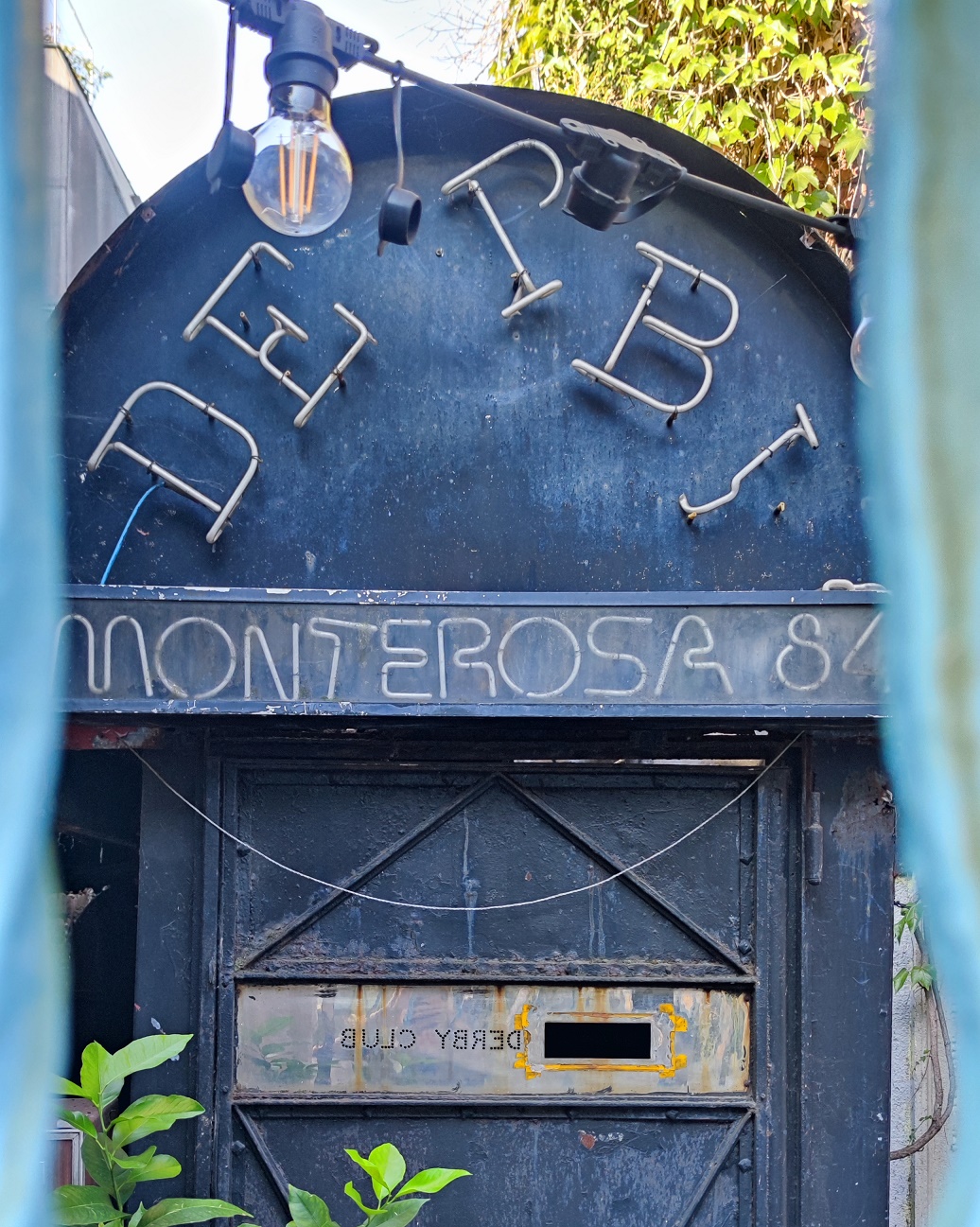
The entrance of the Derby today. It was one of the most important music venues in Milan during the 1960s.
Methodology
The methodological approach is based on deep mapping, a practice grounded in the synergy between visual maps, computational data analysis, and fieldwork.
The reference dataset brings together 8,288 musical events and is built on information drawn from two of the major newspapers of the time, Il Giorno and Il Corriere della Sera.
These data are geographically visualised in interactive digital maps. The same dataset is also analysed through network graphs showing the relationships between venues and music genres, venues and performers, and performers and composers.
Both forms of visualisation were used to catalyse the memories of eight musicians active at the time. The audio-video materials produced through these meetings are displayed in a dedicated digital map, creating a feedback-based synergy between quantitative and qualitative tools.
Explore the materials
All the materials produced during the research are accessible through dedicated pages: